Tag: DH

  • Can “Art Direction” make better digital projects?

    Can “Art Direction” make better digital projects?

    Art direction is not a phrase that I was familiar with in the context of data visualization until I listened to a conversation between Alli Torban, host of the podcast Data Viz Today, and information designer Gabrielle Mérite on Episode 59: How Art Direction Can Make Your Work More Effective. This isn’t a recent episode (November 24, 2020), but the conversation between Torban and Mérite touches on a timeless aspect of visual display of information, which is to say its affective power. Art design, according to Mérite, is the ability to communicate the rhetorical, emotional, and ideological aspects of data in ways that resonate with the audience and with the message. Mérite explains:

    To me, the difference between design and direction, because I think the issue is that most people don’t know the difference, [is that] designis more about problem solving and finding those design solution[s], the visual solution, and art direction is about evoking the right emotion. It’s a bit … about creating that connection between what you’re seeing and what you’re experiencing.

    In other words, in the process of creating effective data visualizations, art direction is a part of the process that integrates the layout, framing, text, and image with the needs of the audience and the message from the data. When the emotional register matches the message (not merely the medium à la Marshall McLuhan), that harmony increases the power of the story the data tells. The idea of art direction may be most familiar in the context of developing a “brand.” In brand design, designers send clients extensive questionnaires that dig into the values, goals, aspirations, and feelings that the clients would like to evoke in relationship to their brand. Setting aside the corporate-speak for a moment, the need to create a cohesive look and feel, user interface, and style guide for a digital humanities project is quite similar. When a project successfully connects with its audience through content and design, the project seems to do more that the sum of its parts.

    How, then, do we teach and evaluate affective coherence within a digital project’s graphic design and user interface? What kinds of skills and literacies do we need to help students develop in order to extend their reasoned, logical, and deeply researched scholarly investigation to include the affective and often rhetorical arguments their projects make to the design, implementation, and administration of those projects?

    As a capstone and thesis advisor, I find this to be one of the tricker aspects of the project to cultivate, because doing so depends upon dialog, iteration, feedback, and sometimes even redesign and change. They are part of a project’s development that extend the timeline of the work, which–in turn–is also a hurdle to completion. The typical capstone project should take only one semester; however, really leaning into the “art direction” of the project means taking time to test, reevaluate, and redo, something that is likely to carry the project on beyond the single semester.

    So far, the way that I have begun to address concerns like these is at the proposal stage. When I’m reading a project proposal for a capstone now, I find myself asking students how they want the audience to feel and how feeling and affect are going to be addressed through the interface or visual and verbal signals embedded into the work. Whether or not that plan is fully realized in the single semester, to me, is less important than evidence that the student has taken time to consider and to account for the “connection between what you’re seeing and what you’re experiencing.” What I say now is that I’d like there to be evidence of intentionality in the project, such as a purposeful selection of color, texture, organization, or technology choice, that extends beyond utility to creating a cohesive experience between the audience’s visual experience and the information conveyed. While the realization of that cohesion may be uneven in the final project, the white paper the student submits should explain where there is evidence of artistic direction in what was produced and what steps the student would take in the future, were they to extend the project, to more fully realize that intent.

    Looking ahead, when I teach in the future, I plan to make changes to my syllabus in order to spend at least one week on art direction, design, and affect. I think that more readings on design, on metacognitive processing and memory, and affect theory will help students to be better prepared to marry the design and the information of the site and to think about the ways in which we create a future for the work that conveys not only what users / audiences learn but how they come to knowledge.

  • NYC Digital Humanities in the Context of Radical Care

    NYC Digital Humanities in the Context of Radical Care

    NYC DH week keynote

    The following paper was delivered as the keynote address for the 2021 NYC DH annual conference to kick off NYC DH week.

    Introduction

    Before I begin, I want to thank Kelley Kreitz for her kind introduction, the members of the NYC DH Steering committee for their sense of trust and confidence in asking me to speak today–especially Madiha Choski, who was going to be the other half of this keynote conversation and who unfortunately came down with COVID last week. Thanks also to those of you who are signed in today for yet another “unprecedented” event to add to the long list of unprecedented events we’ve accumulated this past year. I’m sure the last thing anyone really wants on their Monday is another Zoom call. And yet, what’s true today, and has been true in many kinds of conferences and assemblies that have taken place this year, the number of people who have chosen to come is a testament to how critical people and social connection and support is to the work that we do. Essentially, I read attending a Zoom talk and conversation and breakout group discussions as a form of hope and joy as an act of resistance against so many forces this year that has made, in most cases, doing our work so much more challenging and necessary and fraught. 

    Anecdote

    Let me start, then, by setting the scene and describing briefly the series of events that led us to wanting to kick off a week of Digital Humanities community and coalition building under the umbrella of “care and repair” and which led to thinking about Care as a radical act in our NYC DH community, especially as it is framed by instances of crisis, trauma, and upheaval over the past year. 

    October 2020, when the Steering Committee first met, seems like almost another world now, and that October felt like an altogether other world than the one we occupied at this event in February 2020. At the meeting were Jesse Merandy, Kimon Kirmedes, Elizabeth Cornell, Chris Alen Sula, Madiha Choski, Zach Coble, Stephen Klein, Kelley Kreitz, and myself. What stood out to us about the meeting, was how compelled we were to ask, “How are you?” and “Are you ok?” And no, not that superficial “How are you?” but the one that is looking for an honest answer, and we were likewise struck by how grateful we felt to hear each other answer. It was as simple and obvious and ordinary as it sounds–something we would not have imagined as “radical” by any stretch of the imagination. And, it’s really not. Except,that it is. What the events of the past year have underscored is how very radical even modest care work can be given the contexts in which it is deployed, and how showing up for one another in more modest circumstances, might also lead to showing up for one another in other ways.

    As Kimon Kirmidas often reminds us in our meetings: “This Steering Committee is composed of some of the busiest folks in our community who still come together each year on a completely volunteer basis to do even more.” I’d add to this by saying that our work is an act of investment and faith that is often at odds with institutional values. That we even begin to pull this event together along with an online community, graduate student awards, and workshops is annually at odds with the transactional values of our home institutions–in other words, the primary function of our collective efforts is not to engage in academic and intellectual commerce, but to sustain the people and values who are most likely to be under duress given their institutional positions and demands. We’re not participating because it increases the value or the prestige of our home institutions or ourselves (though, it may have that secondary effect sometimes). Our coming together to ask and to share how we are, to create a week of free workshops and working groups across NYC, to recognize and reward graduate research in digital humanities, is instead a rejection of the narratives of scarcity and limited resources, a refusal of resource hoarding as a response to those narratives, and an act of joy and hopefulness in the pursuit of an otherwise–an idea that comes from Elizabeth Povinelli’s anthropological studies of the gift economy in which under duress, creating space for care is an act of hope–a kind of audacity that suggests that though we’re unable to completely divest ourselves from oppressive structural inequities and normative assumptions, our activities as individuals and collectives might lead us toward something better. 

    It is this continual hope of an otherwise that has led us toward a “calling in” that is to say a place where we invite one another in to share who and how we are, to reconcile varied privileges and constraints of our situations, and to commit to a collective care that through success, error, iteration, and commitment might help make participation in the DH community across and beyond New York City more welcoming, reaffirming, and even sustainable in spite of (rather than in service of) our specific institutional situations. 

    Setting this year in Context

    As Kelley mentioned in the introduction, our hope is to focus collective attention and action on the relationship between individual digital humanists and NYCDH as a community of practice impacted by ongoing crises and traumas, such as the COVID-19 pandemic, racial injustice and the surveillance state, budget austerity and scarcity, exploitative labor conditions, and rapid pedagogical transition that over the past year have exposed the ongoing inequitable conditions in which we have been doing our work. This list is far from exhaustive, but is the list where I’ll begin my talk today, retaining a focus on the more local for now. I want to reflect on what the small act of asking: “How are you doing? Are you ok?” in our steering committee meeting extends far beyond niceties to the opportunity for radical care as an act of hope. It is in microcosm a gesture from which the impulse to come together as a community of practice to truly see one another, recognizing and acting upon our mutual humanity becomes a first step toward solidarity and collective action. 

    Why am I mentioning this? Because the overwhelming feeling of care and solidarity that we felt at that moment is also what we collectively agreed was most needed and also most possible to achieve this week–that what New Yorkers–now past the one-year anniversary of the first recorded COVID-19 case in the New York Metro area–needed was the opportunity truly to ask and to hear from one another “How are you doing? Are you ok?” This week provides us with a chance to recognize, call for, and demonstrate an ethic of care when the need for repair feels most urgent and–frankly–daunting. What the past year has made most stark and apparent is the racial injustices that have long been part of our institutions and where digital surveillance, public health crises, and economic disparities have sparked wider public outrage and attention–but also have elicited the basest and most dehumanizing aspects of public life. The result has meant increased vulnerability, emotional labor, and distress. We have seen our teaching and pedagogical values challenged as many of us try to balance our commitment to people, to embodiment and connection and dialogue with issues of safety, health, and well-being. Often for those in digital humanities roles that means making choices we otherwise would prefer not to make or to become complicit in choices that in any other time we would have more options to resist, such as decisions to use proprietary, or opportunistic enterprise “solutions” to problems that are at their core social and fiscal. The people most likely to be here, at this talk and participating in this week’s events, are also more likely than not to occupy vulnerable, or contingent positions–graduate students, librarians, staff, or faculty who take on the lion’s share of committee work, whose positions are in some way under threat, in question, or under siege–and that is all before we get to the question of immigration status. For many of those in the NYC DH community, including more than ½ of the graduate students I work with–the Trump administration’s callous and opportunistic approach to the pandemic has led to a reliance on digital technologies that often legitimize zenophobic federal policies, leaving students and colleagues in a perpetual state of anxiety and uncertainty. 

    Moreover, this year has lain bare something else that we have always known, but that has been conveniently elided as institutions of higher learning, libraries, and cultural heritage organizations have faced austerity measure after austerity measure–our professional lives and our personal lives, our intellectual lives and our physical selves, our roles as digital humanists and the other roles we play in our personal and professional lives are not separate. We see this playing out in conversations about “personal responsibility” and risk with regard to the coronavirus. Our lives as people who care for family members–children or parents, partners or spouses, neighbors and others–are not separate from the work we do, especially when the work we do this year entered into our homes, breaking down any semblance of barriers that we might have erected for the purpose of necessary self preservation. 

    This breaking down of boundaries and the consequent impact that affective labor has had on faculty and staff is occupied much public conversation in places like The Chronicle of Higher Education and Inside Higher Ed–the majority of them either valorizing faculty willingness to over extend themselves, or pointing to self-help tips and tricks that turn structural failures into personal ones. In reaction to this, Lee Skallerup Bessette’s article in the Chronicle of Higher Education in October titled “The Staff Are Not OK” makes this point quite clear. She writes “It’s time higher education started paying attention to the health and well-being of the staff members whose work has pulled campuses through the Covid-19 crisis.” Bessette points to the way that staff are often tasked with the emotionally exhausting work required to transition faculty from face-to-face teaching to remote instruction. She explains: “Most of us just spent our summers working overtime to ensure that the campus was ready–in whatever format that entailed–for the fall. Many staff members were required to put their health and safety on the line to be on the campus, while others had to fight for the right to work remotely. Hiring freezes have meant more work with fewer people. Wage freezes and furloughs have stretched us to our limits.” And I might add that as the statistics bear out, many of these staff positions are held by women who, as a bevy of other Chronicle articles have pointed out, are falling behind in their research productivity balancing work with care taking, especially of young children who are participating in remote instruction themselves. Where there was the illusion of boundaries between the personal and the professional, between home and work–the past year in more ways that one has exposed the false pretense of that binary. And yet, even exposed, the response from most institutions has overwhelmingly been through the language of self-determinism and personal responsibility. 

    Feeling depressed and isolated? Try taking a workshop. Working so many hours that you’re body is tied in knots? Take this ergonomics survey to improve your posture. Having trouble making meetings while supervising your kindergartener? Try some of this online content to keep them busy… 

    The point that I’m trying to make here is that in October, when the NYC DH Steering Committee came together to meet and we asked each other “How are you? Are you ok?” For some of us, it was the first time that we’d been asked that question with a genuine interest in the answer. Not with a redirection to self help or the implicit desire to ask something more of one another. It was at this moment that we felt a resurgence of hope for what NYC DH could be. A network of care that transcends the institutional exigencies, austerity measures, and competitive values of intellectual commerce. One that resists the capitalist myth of limited resources that lead to hoarding and competition. What NYC DH could offer is an otherwise–a space where we can reaffirm our humanity, share the resources we have, and focus on the ways that minimal collective effort could lead to interpersonal connection and opportunities for something better.

    Before going any further, I also want to name an obvious disconnect here between the fact that I’ve mentioned talking about racial injustice as one of the major contributors to the past years’ crises and trauma and the fact that my lived experience position me in ways in which I can speak with authenticity about the toll that racial inequity has taken on DH communities of color. In fact, there are many women and people of color who are part of our NYCDH community who have been working at the intersection of race, social justice, and digital humanities for a long time and who could speak with the power of experience and expertise. That point did not escape the members of the Steering Committee as they thought about who should speak today, and I want to address the situation directly. Obviously, it would make sense to have one of the many scholars of color in our community giving this talk, but we also recognized that doing so would potentially add to the disproportionate burden of affective labor many women-identifying Black Indigenous People of Color are taking on and while perhaps such a thing is more reasonable when we could compensate them for their time, this year we did not feel that we would be able to do so adequately enough to reward them appropriately for the work involved. 

    So, I’m not going to use my time to try to describe a situation or affective labor that is not part of my lived experience. I am instead directing my remarks toward how we might come to think of radical care, following and citing the leadership of Black feminist philosophers, pedagogues, and poets. I want to encourage us, especially those of us who are white, to focus our attention on how participating in acts of radical care can lead us to exposing and dismantling structures of white supremacy in digital humanities practice. How might someone like me, a white, CIS, straight, alt-ac digital humanist, pursue liberation during these challenging times, when individual and collective action confront the normalizing forces of institutionalized oppression? And, by extension, what might we do as a community to act in solidarity and recognition that there is much to be done to help lift one another up as we move forward toward what I’ve already referred to as an otherwise. 

    Scaffolding

    What I intend to do over the next 30 minutes or so is to consider what “radical care” might be in the context of NYCDH. What makes care “radical” and what are the normalizing forces that delegitimize care work, threatening to make affective labor an agent of oppressive structural regimes rather than a vehicle for solidarity and change. Then, I’ll consider the kind of activities that projects I’ve been involved in and those that others, like Madiha, have been participating in–looking at sites of radical care that already exist within our NYC DH community. Finally, I’ll turn toward Opportunities that I see for “radical care” moving forward that draw on past work and imagine a more hopeful “otherwise” of inclusive digital humanities practice in the future. From that point, we’d like to open the conversation up more broadly to include other members of the Steering Committee and their thoughts regarding the possible futures of radical care in the NYCDH context, and then open conversation even further again through breakout groups… that may echo the questions posed to the working groups who will be meeting on topics throughout the week. 

    Defining Radical Care

    Conversations framed by a feminist ethics of care, particularly Black feminism’s ethics of care, since 2016 have become commonplace. They focus on the affective, economic, physical, and professional toll that the Trump Administration had on institutions of higher education, legitimizing acts of white supremacy, state violence, and surveillance on campuses across the United States. Then, in 2020 when the coronavirus began to spread rapidly across the US, what might be considered an ethics of care expanded considerably, under the increasingly transactional and financial pressures placed on many of us by the institutions where we work. In an interview with Yes! Magazine in February 2016, Angela Davis comments, “I think our notions of what counts as radical have changed over time. Self-care and healing and attention to the body and the spiritual dimension—all of this is now a part of radical social justice struggles. That wasn’t the case before.” But as we all know, the entry of a liberatory or radical concept into the popular lexicon is generally accompanied with the dilution of the real purpose of the term. So, let me take a few moments now to parse between the popular and oppressive valences of an ethics of care in contrast to the self and community-sustaining ethics of care that Davis describes as “radical.”

    At its core, “radical care” resists dehumanization, whether the origin of that dehumanization is institutional, corporate, economic, technological, or racialized. In other words, care is the radical and fundamental act of preservation, a strategy for survival and change rooted in the recognition that caring is an inherently political act that calls into question who cares and for whom. In particular, there are two forms of care that I want to focus in on today: self care and collective care. When Audre Lorde insists in A Burst of Light that “Caring for myself is not self-indulgence, it is self-preservation, and that is an act of political warfare,”she is not talking about the form of self-care that we might find discussed in popular publications today that consider, for example, how universities can promote “wellness campaigns” to help individual faculty and staff manage their mental and physical health while working extended hours, from home, without childcare. For Lorde, self-care while fighting liver cancer became an act of defiance in a system designed to deny her humanity as a Black, lesbian woman with a voice. Sarah Ahmed extends Lorde’s assertion by saying that “for those who have to insist they matter to matter: selfcare is warfare.” 

    However, as I’ve already mentioned, self-care in the context of Covid-19 on campuses is typically formulated as the need to “take care of one’s self” in an abnegation of the responsibility that institutional pressures and demands play in creating the need for self-care. Self-care in the institutional context is an activity for which advice is provided through workshops, emails with resources, or HR campaigns that unburden the institution of their complicity in overloading faculty and staff with enormous amounts of affective labor resulting from transitioning from face-to-face to virtual  learning with very little time or increased class sizes or patron’s unwillingness to wear a mask. Of course, there is a place for self-care in an ethic of care–but that for care to be radical, it must resist the inclination to do so in order to smooth frictions that make the academic industrial complex continue to chug along unabated. 

    Importantly, self-care may be more radical for some than for others, therefore, a radical ethic of care also depends upon an assertion of collectivity and shared action in the face of forces that are purposefully individualistic and unnecessarily competitive. Situations, for example, where the desire to reopen and the personal health and safety of the faculty and staff are at odds, normalizing the logic that self-care and collective well being cannot coexist. And whether we acknowledge it or not, this is a similar logic to that of a white supremacy which prevents class solidarity. 

    I would argue that radical care in this moment, and in the context of NYCDH resists these false binaries by creating connections across and among institutional, professional, and geographic boundaries and differences to lift up and to care for as opposed to self-investment and interest–not as a solution to resource scarcity, but as a means of surviving it. 

    Importantly, a radical ethics of care is not about charity. It is not about those of us at institutions with better endowments and more resources participating in some sort of “savior” fantasy. Radical care in the context of NYC DH looks more like mutual aid, fueled by reciprocity and recognition of the shared strengths and expertise that our various formations, experiences, and perspectives provide. Finally, radical care in the context of NYC DH is not the same as “agreement.” What is “radical” in this context is that the energy that animates our community operates outside our individual institutional values. It is the collectivity across the roles that we play at our institutions, and our coming together to share with, to care for, to show up for one another. It is the collective recognition of shared–which is not to say the “same”–struggles and values that helps to create a sense of kinship and concern that is also sustaining. 

    Sites of “Radical Care” in DH 

    From here, I’d like to pivot to examples of digital humanities driven by an ethic of radical care from my and Madiha’s experience, across NYC DH and beyond it. The examples that I’d like to draw from, however, may not be explicitly covid-related–though some are. What these projects do provide is a way to think beyond the current crisis toward a more sustainable and collective future–one in which the lessons of the present remain with us as we navigate beyond it to what we hope to be a better place.

    Covid Maker Response – Resource sharing

    The first example, though, is a project that Madiha Choski brought to fruition–the Covid Maker Response. I’m going to mention it here, in hopes that Madiha will be able to elaborate upon it later, but if not I want to make sure that it’s front and center in your mind to go back to and learn about. In March, when New York City’s activities ground to a halt and hospitalizations skyrocketed, as we all know, many hospitals faced a shortage of personal protective equipment, or PPE. Dr. Pierre Elias, a Cardiology fellow at Columbia University, contacted Madiha to ask whether or not the libraries’ 3D printers were able to produce face shields. Choski researched various patterns, requested permission to go to campus and to bring 3D printers to her home, and she began printing and assembling the shields. Choski organized her library colleagues and campus and community volunteers to the point that they could print 1,000 face shields per day and deliver them to local hospitals. Reaching out to 3D printing companies MakerBot and Tangible Creative, they were able to improve the speed and efficiency of the visor production. 

    The Covid Maker Response is an excellent demonstration of the way in which resource sharing and collective action in conversation with communities in need can work in solidarity. 

    CUNY Distance Learning Archive – Pedagogy and Archives

    In Spring 2020, students in Matt Gold’s doctoral seminar “Knowledge Infrastructures” had planned to “explore the emerging nexus of critical infrastructure studies and critical university studies, focusing on the infrastructure of scholarly knowledge.” When campuses closed and face-to-face learning was rapidly transformed to meet the demands of remote and virtual learning, Gold’s class developed a collaborative and timely project in response to the ruptures and displacements that students, faculty, and staff were feeling. The archive catalogues the wide range of mixed messages faculty and students received about next steps, partial and quixotic guidance on grading, course format, and schedules, and privileged the lived experience of students and faculty in their collection practices. This is a stark contrast to what one might find if you were, for example, to look over CUNY’s websites and archives of memoranda, and demonstrates in practice principles that Catherine D’Ignazio and Lauren Klein describe in Data Feminisms, “Elevate Emotion and Embodiment” Data feminism teaches us to value multiple forms of knowledge, including the knowledge that comes from people as living, feeling bodies in the world.” 

    What the CUNY Distance Learning Archive commemorates is the embodied experience of teaching and learning in the midst of a global health crisis that is differentially animated among members of the CUNY community, preserving the sense of precarity, uncertainty, and resilience that–while heralded–is likely to go unrecognized and rewarded once financial and resource scarcity and calls for austerity resume–as was the case in Fall 2020, when adjunct faculty contracts were not renewed, when minimum class enrollment was increased, and faculty sabbaticals and research time was reduced or postponed. 

    NYC Covid-19 Oral History, Narrative and Memory Project

    A similar project at Columbia University is the “NYC Covid 19 Oral History, Narrative and Memory Archive,” at the Interdisciplinary Center for Innovative Theory and Empirics. The project focuses on New York as a city of neighborhoods, illuminating and documenting the social structures that shape our experience of the pandemic. Building on lessons learned from the September 11, 2001 Oral History Narrative and Memory Project, a composite of oral histories, diary entries, survey data, and mapping visualizations to convey the differential ways in which the pandemic has impacted New Yorkers in their daily lives. 

    Digital Humanities Research Institutes – Professional development and research

    I’m going to shift a bit to talk about a project of my own in which sustainable growth and resource sharing created professional development opportunities that reach digital humanities practitioners in locations where there might be limited local resources. The Digital Humanities Research Institutes (GCDRI) is project that I lead at the Graduate Center received funding long before the Covid-19 pandemic, and we were in the process of soliciting and evaluating applications when campuses shut down and travel came to a halt. The Digital Humanities Research Institute is the second of its kind, and like the one that came before it, was based on a curriculum and pedagogy developed by CUNY graduate students–namely the GC Digital Fellows (a program that I direct)–for CUNY students, faculty, and staff. 

    What we discovered is that working with a population of CUNY students, faculty, and staff offered us a unique perspective into the barriers that many face when learning technology skills for the first time. We were also increasingly cognizant of the fact that it takes a lot of resources to do community-building and workshop development in digital humanities–resources that are uncommon at Historically Black Colleges and Universities, small liberal arts colleges, independent libraries, museums, and cultural heritage organizations, and community colleges. So our NEH Digital Humanities Research Institute was designed to take the workshop materials and pedagogical approach that we had developed and make it usable to those who did not have the same opportunities but who faced similar pressures. 

    The model worked exceedingly well. In 2018, sixteen emerging digital humanities practitioners came to the Graduate Center. As a part of our application process, we asked for letters of support from each applicant’s institution, which helped to secure a commitment on behalf of their institution to recognize and value the applicant’s labor. We offered a week of core digital skill workshops and panels, and then worked with each participant to begin to develop a local version of the institute that they would offer on their campus. 

    In other words, the Digital Humanities Research Institute is based on the fundamental value that resources are meant to be shared, and through sharing and collective practice, we create more opportunities. Where professional disenfranchisement, resource scarcity, and disciplinary siloing serve as dehumanizing forces in digital humanities practice–like many DH projects–we believe that radical care means acting in opposition to those narratives to create connection, to share, and to support activities across institutional boundaries, which in effect creates a more sustainable and humane community of DH practice. As Freire says, “The only effective instrument in the process of re-humanization is humanizing pedagogy.” 

    But responding to the health threat that COVID presened us with difficult choices about what our core values as an institute are, and how we might remain true to those throughout our “pivot.” How do we center the humanizing forces of dh pedagogy and labor while offering the institute safely and remotely? 

    Our decision was to lean to a commitment to solidarity, collectivity, and resource sharing. Rather than simply moving the institutes online, synchronously, over Zoom, we overhauled the curriculum to provide access to greater numbers of people. We revisited the curriculum to consider the additional demands that  transitioning to asynchronous learning might entail, and creating a more robust, user-friendly, and resource rich interface so that our institute participants, whom we hope to work with this year, will be able to offer similar workshops at a safe social distance.

    We’re currently user testing the institute’s curriculum website, which you can access at https://curriculum.dhinstitutes.org. 

    DH Week Workshops

    The Digital Humanities Research Institutes in large part take their cue from the kind of energy and ethic of care that has mobilized DH Week workshops for the past six years. Each year, we put out a call to those in our local DH community to offer workshops that are free and open to the public on technologies, topics, methods, tools, and projects in digital humanities, and each year we receive an overwhelming response from those who are willing to share their time and expertise. Just as importantly, we receive hundreds of registrations for those workshops. This year, I believe we have something in excess of a thousand registrations–demonstrating not just the richness and diversity of DH practice in and around New York (and this year also Abu Dhabi), but also the keen interest and need for opportunities to learn. 

    Where institutions facing budget cuts and austerity measures are typically unable to support cross registration for their local workshops, NYC DH achieves a powerful act of solidarity and resource sharing that promotes connection and collective professional support. More akin to “mutual aid” than “charity” the reciprocity of NYC DH week workshops is a powerful testament to how we as a community can work across institutional, professional, and fiscal silos–a practice that recognizes our shared humanity and need for connection and support. 

    Opportunities for Radical Care

    The projects I’ve listed so far fall far short of the many examples of an ethics of care at work in DH practice. They are meant to be suggestive, and a starting point for what we hope will grow into a larger conversation across breakout groups today and working groups throughout the week. We are eager to hear from those of you here about the work that you have done to resist narratives of scarcity, the false logic of self-care to support structural inequities, and to reassert and humanize humanistic teaching, research, and service over the past year. 

    But before I turn things over, I wanted to share with you a few projects and examples outside of our NYCDH community that might offer us insights into how we as a community of DH practice might approach radical care moving forward. For example, where are there opportunities for collectivity, critique, self-care, and change that will bring us in greater solidarity with each other and those among us for who “have to insist they matter to matter” in our daily practice. 

    DPLA’s Black Women’s Suffrage Digital Collection

    One example of a project where I see a transformative ethic of care in practice that we might learn from is the Black Women’s Suffrage Digital Collection and Portal, a collaborative project hosted by the Digital Public Library of America. The project aggregates materials related to Black Women’s Suffrage from across 4,000 institutions. While the number of items in the collection continues to grow, so too do the number of curated exhibits and contextualizing documentation, such as timelines. The project, developed in collaboration with the Amistat Research Center, Atlanta University Center Robert W. Woodruff Library, Charlotte Mecklenburg Library, Tuskegee University Libraries, among others, provides us with an example of how digital curatorial practices can work toward liberation and social justice. The project led to DPLA’s creation of a “Statement on Potentially Harmful Content.” Born out of a collaboration with researchers, scholars, and librarians, the Black Women’s Suffrage Digital Collection surfaces materials, along with metadata and descriptive practices that may be harmful. (https://blackwomenssuffrage.dp.la/harmful-language-statement). While the statement acknowledges the existence of racist and misogynoir views, it also affirms DPLA’s commitment to working with the communities impacted by harmful collection and metadata description, informing users of its presence, revising descriptions and standardized descriptive terms by supplementing them with more respectful terms or by creating new standardized ones, and by continuing to research, listen to users, and share their work. The project invites users to report instances of harmful content, as well. 

    The project is also noteworthy also for its approach to aggregation. A close collaboration between DPLA’s Shanee Y. Murrain and Audrey Altman and subject area experts ranging from librarians to scholars in African American History created an algorithmic aggregator built upon a combination of boolean operators and human curation. Working together, they assembled key boolean search terms that could help automatically filter items deposited into DPLA, through a process of trial, iteration, and revision, the process demonstrates how collaborations across disciplinary, professional, intellectual, and personal difference can work towards liberation. 

    ACH’s Resource on Anti-Racist Technical Terminology and Portraits in DH

    ACH, like many other organizations and institutions over the summer, crafted a statement on Black Lives Matter as the murders of George Floyd, Breonna Taylor, Daniel Prude, Rashard Brooks, and too many others brought long-standing frustration over white supremacy in policing practices into the foreground of media attention and popular culture. Acknowledging the many calls that scholars of color in Digital Humanities, such as Moya Bailey, have made for a field-wide reckoning around the role that technologies have had in institutionalizing racial oppression, the Association for Computers and the Humanities is working to fulfill its stated commitment. Through a community-sourced initiative, Executive Committee members have produced a living document that addresses racist language common in technology use. (https://ach.org/toward-anti-racist-technical-terminology/) Accompanying the project is an open Zotero group library with readings that address the racialized language of technology tools and methods.

    Digital Humanities, much like academic libraries and humanities faculties, suffers from the underrepresentation of practitioners of color. All too often, lack of representation in professional practice in these areas is framed as a “pipeline” problem: blaming a lack of diversity on the inaccessibility of training or pathways to education. However, research by scholars like Frank Tuitt points instead to a culture problem: it’s the lack of promotion, support, solidarity, mentoring, and professional opportunity, not to mention community–essentially the hostile structural and social climates in which we work–that are more likely to lead to librarians, faculty, and DH practitioners leaving the field. Projects, then, like “Portraits in DH” are designed to raise the professional visibility of scholars of color, not only promoting the work of emerging and established figures in digital humanities who are BIPOC, but also creating a sense of connection and visibility across institutional settings. I would challenge us to do the same, creating more explicit opportunities for professional recognition and growth, as well as connection and mentoring, to support digital humanities work by local faculty, students, librarians, and staff who are BIPOC. 

    Valuation and Evaluation as an Ethic of Care

    Again, my list here is meant to be suggestive and far from comprehensive, but I would be remiss if I didn’t at least gesture to the ways in which Digital Humanities work is often connected to conversations about what we value in the humanities and how we value it. Valuation and evaluations, as Kathleen Fitzpatric points out in her new project (https://kfitz.info/leading-generously/), which builds in practical ways on her recently published Generous Thinking, is intrinsically connected to leadership. Characteristically, Fitzpatrick is writing and thinking out in the open on her blog, and Leading Generously is a challenge to action–not just for digital humanists, but to all humanists, to examine what agency we have and what values we want to see in the academy and cultural heritage organizations of the future. Similarly projects such as the Mellon-funded Humetricss project (https://humetricshss.org/) are hosting workshops and leading conversations among humanists, digital or not, to come together and form a sense of solidarity around “values-enacted frameworks for understanding and evaluating aspects of the scholarly life well-lived.” I’ll note in the interest of full disclosure that my spouse is one of the co-PIs of the project, along with Chris Long from Michigan State, but the preponderance of the Humetricss team is now or was at some point New York City-based. <https://humetricshss.org/about/the-team/>. And it might be worth considering how their “Workshop Kit” might be something that future NYC DH events could make use of to energize cross-institutional conversations about building a local digital humanities practice that shows up for one another in solidarity across institutions reinforcing one another’s work as we strive to create a more humane environment in which to do our work. 

    Working Groups

    My purpose in highlighting these projects is forward looking and action-oriented. When we agreed upon “Care and Repair” as a theme for this week, we wanted to move beyond the affective sense of connection and solidarity toward actions–tangible ways in which we, as a community, could operate out of an ethics of care to share resources, to create space for solidarity, and to mobilize collective action. We imagined that this activity might take any number of shapes, and so we added a new element to the schedule, working groups that will meet on Tuesday, Wednesday, and Thursday afternoons. These meetings, facilitated by NYC DH Steering Committee members, center on an aspects of our shared professional, personal, research, and teaching lives as digital humanists: such as advocating for humanities and digital humanities within institutional settings, setting up diverse and accessible classroom communities with digital tools, and strategies for undertaking interdisciplinary scholarship and working collaboratively. 

    But we don’t need to stop there, and I encourage you to consider areas where you can contribute. Is there a need for solidarity and collective action that you are interested in and want to pursue? If so, following this talk, we’ll be opening up breakout rooms and creating space for networking and conversation, and we encourage you to use this time to connect with other practitioners and members of the NYCDH community and begin these conversations, and let us know how we can be helpful. 

    In conclusion, I want to recognize the enormous amount of affective and uncompensated labor that goes into putting an event like NYC DH on. Thank you to the members of the NYC DH Steering Committee who have put untold numbers of hours, care, and attention into making this event possible. 

    Finally, what makes care in the context of NYC DH radical is that it is an act of joy. It is neither charity nor self-help. As fellow NYC DHer Micki McGee writes, the structural oppression of the “care economy” depends upon low- and no- wage care workers without whom our fragile systems of productivity would collapse–but NYC DH has the potential to resist the false logic of a “care economy.” Through reciprocity, information and resource sharing, solidarity formation, and collective action we can and might still find new ways to stand up for one another and for an otherwise that is promised but never assured. 

  • The Story of Stopwords: Topic Modeling an Ekphrastic Tradition

    The Story of Stopwords: Topic Modeling an Ekphrastic Tradition

    The following paper was first presented on July 9, 2014 at DH2014 in Lausanne, Switzerland. The slides can be found here.

    The story I’d like to tell you today is about exploring hermeneutic spaces between poetic convention and artistic invention. It’s a story about the strict algorithmic logic of topic models confronted by the rich ambiguity of poetry to revise long-standing critical assumptions about the syntactic and semantic compression of poetry. It might even be considered a cautionary tale about how exclusively relying on close reading of texts diminishes our interpretive reach. The story I’m going to tell you features the critical tradition of ekphrasis—poetry to, for, and about the visual arts—as it unfolds through a digitally-enabled, critical deformance that occurs while preparing and modeling a corpus of 4,500 English-language poems with the latent dirichlet allocation algorithm, commonly called topic modeling. [Slide 2]

    The purpose of my story is three-fold: First, to demonstrate through a case study the influence of stopword removal on topic models of poetic corpora. Second, to suggest one way we may respond to the concerns of skeptical poetry scholars about the practical and methodological constraints of distant reading practices such as topic modeling. And, third, to reveal one way in which my understanding of ekphrasis has transformed through an active engagement with the formal constraints of distant reading practices. [Slide 3]

    The work I’m going to discuss today is part of a larger project in which I look at the critical and poetic tradition of ekphrasis, its genre definitions and conventions, as well as its treatment of women as active participants in a tradition of looking at and writing about the visual arts. In the twentieth and twenty first centuries, poetic engagements with the visual arts, in this genre called ekphrasis—have drawn from and reshaped a Western tradition of viewing, describing, creating, and narrating images. From W.H. Auden’s “Musée des Beaux Arts” to Jorie Graham’s “San Sepolcro,” poetic conversations between the visual and verbal arts are as active as they have ever been since Homer’s first description of the shield of Achilles in The Iliad (18.483-601). Likewise over the 20th century, our critical understanding of the genre has also evolved. For example, Jean Hagstrum’s 1950 book The Sister Arts describes ekphrasis as “pictoral” poetry, while New Critics Joseph Frank and Murray Kreiger adopt the term to describe the realization of an image through poetic form. More recently W.J.T. Mitchell in 1992 redefines ekphrasis as “the verbal representation of visual representation”—a move that signals a methodological shift away from a metaphorical comparison of the arts of poetry and painting toward a semiotic and cultural approach.

    Similarly, my own study addresses methodological challenges faced by scholars of ekphrasis as they consider its active tradition. As significant and transformative as Mitchell’s contributions have been, “Ekphrasis and the Other” is limited in ways that are difficult to ignore in today’s critical landscape. Specifically, Mitchell’s “Ekphrasis and the Other” is based on four poems by white, male either British Romantic or American Modernist authors:[Slide 4]

    • Wallace Stevens’ “Anecdote of a Jar”;
    • William Carlos Williams’ “Portrait of a Lady”;
    • John Keats’ “Ode on a Grecian Urn”;
    • Percy B. Shelley’s “On the Medusa of Leonardo Da Vinci in the Florentine Gallery.”

    In fact, whether it be in essay or monograph form, the most poems considered in any critical definition of the genre is 75; and of all of those collections, only a handful have included examples of ekphrastic poetry by women. So when Mitchell’s essay confidently concludes: [Slide 5]

    My examples are canonical in their staging of ekphrasis as a suturing of dominant gender stereotypes into the semiotic structure of the imagetext, the image identified as feminine, the speaking / seeing subject of the text identified as masculine.

    It’s difficult to read such a conclusion without some skepticism. While Mitchell’s and others such as James A.W. Heffernan suggest that the “treatment of the ekphrastic image as female other is commonplace in the genre,” numerous feminist scholars, such as Beth Loizeaux, Barbara Fischer, Jane Hedley, Anne Keefe, and Bonnie Costello caution us against the dangers of reading ekphrasis as an overly-determined gendered contest, suggesting that women in the 20th century write with a much more nuanced attitude toward the gendered dynamics of ekphrasis. However, moving beyond Mitchell’s description has proven difficult. The genre’s saturation with frequently used and gendered terms such as “see,” “say,” “look” and “still” ” – all associated with either a dominant male gaze or a still, passive female figure—complicate our access to other critical approaches at close distance.

    I came to this particular project, then, with an explicit intent to uncover methodological means for expanding the number of poems we can consider at one time, as well as a method for detecting latent patterns across texts that were perhaps to this point obscured from view. My project, Revising Ekphrasis, asks what opportunities distant reading practices, such as topic modeling, present scholars of ekphrasis as a means for casting the widest possible net to detect latent patterns across an increasingly diverse corpus of ekphastic poetry. [Slide 6] The Revising Ekphrasis dataset includes 4,771 poems (documents) from three kinds of poetic corpora: The American Academy of Poets, Poetry Daily, and print anthologies of ekphrastic poetry. The collection, breaks down in the following way: 2,466 from the American Academy of Poets website; 373 from Poetry Daily (2011 – 2012); 34 from a print anthology titled The Gazer’s Spirit by John Hollander; 79 poems discovered through Poets on Paintings: A Bibliography by Robert Denhem; 19 poems by Jorie Graham, Carol Snow, Barbara Guest, and Cole Swenson. I also lightly described the dataset as “ekphrastic,” “nonekphrastic” or “unknown” and discovered that about 425 could be identified as ekphrastic.

    I chose topic modeling because critical treatments of ekphrasis often hinge upon perceptions that the genre uses a higher ratio of words relating to “stillness” and words relating to “look” and “see” than other genres. Questions about recurring patterns of term across similar texts are excellent kinds of questions to explore with topic modeling in theory; however, topic modeling best practices suggest that words such as “see” and “say” and “still,” which are considered high-frequency, low-semantic value terms known as stopwords. [Slide 7] Stopwords, as you likely already know, are typically removed from the dataset entirely in order to improve the quality of the model’s results. So, I was confronted right away with a dilemma, could I still get useful, reliable, and interesting results from topic modeling if all the words considered to be most influential to the genre’s definition were removed?

    As a literary critic, the idea of removing so many words from a dataset of poetry seemed preposterous at first. Auden’s opening line, for example, “About suffering they were never wrong, / the Old Masters: how well they understood…” would be dramatically different if instead it read:[Slide 8] “suffering wrong masters understood.” Robert Browning’s pivotal line in “My Last Duchess,” [Slide 9]”she looked on, and her looks went everywhere” justifying the duke’s “silencing” of his wife would be removed [Slide 10] entirely from the text of the poem if I were to use the default preprocessing steps for MALLET, the software I chose to use for my topic modeling.

    In order to feel any sense of confidence about the kind of results I would be generating, I first needed to know how the “standard” stopword removal process would influence results, so I designed a test to see how the presence of stopwords affected the usefulness of the topic keyword distributions the LDA produced.  [Slide 11] Without introducing the LDA process in detail here, what is useful to know is that LDA is an algorithm that sorts through documents and creates groupings of words that are most likely to co-occur in similar documents. Topic modeling produces distributions of words, vocabularies, that are most likely to be found in similar documents, which are called “topics,” and these distributions frequently enjoy thematic coherence.

    My tests were designed to foreground the presence or absence of important ekphrastic words, such as look, see, still, and stillness in order to expose how their absence or presence influenced the topic model’s keyword distributions—those lists of key words that topic models spit out. I imported the entire text dataset into MALLET using four different stopword lists, then ran a 40 topic model. [Slide 12]

    In the first test, I skipped preprocessing altogether, leaving every word in tact in the corpus. In the second, I heavily edited the MALLET stoplist, so that only 200 words were removed from the dataset, including adverbs (accordingly, actually, and usually); articles (a, the); and conjunctions (and, or). The third test only slightly modifies the stoplist, removing 510 high-frequency words, but leaving words frequently associated with ekphrasis in the text to be modeled, such as: after, before, look, looking, looked, looks, said, saw, say, saying, says, see, sees, seeing. Finally, I ran the last test using MALLET’s default stoplist of all 538 words.

    Rather than focusing on the significance of the individual topics to the composition of the whole model, I want to focus on the composition of the topics themselves. For those unfamiliar with reading topic model results, the number on the far left represents the topic number, [Slide 13] in this case from 0-39 because 40 topics were requested. The next number, called a hyperparameter estimation, shows the model’s prediction as to how much of the collection might be described by each topic. Next, to the right of the hyperparameter estimation are the top 20 words associated with the topic in descending order from most likely to least likely called “keys”.

    When too many high-frequency words were left in the dataset, the signal-to-noise ratio became too high to interpret the word distributions. Results from the first test are almost too difficult to read. While literary scholars of ekphrasis have understood words such as “see” and “say” and “look” to be more prominent in ekphrastic poetry than in other poetic genre, the degree to which those words are more frequently used is not significant enough to create an “ekphrastic” topic. For example, [Slide 14] topic 8 is dominated by frequently used verbs: “was, and, a, had, were, that, in, it, to, said, but, could, did, came, when, saw, they, then, I, one.” While the topic includes the word “saw,” which might be interesting in terms of understanding ekphrastic poetry, in this case it does little to identify a trend regarding ekphrastic “looking.” Instead, the topics with the highest proportions, such as Topic 1 [Slide 15], represent distributions of articles and pronouns, offering little insight into the texts themselves.

    The results from the second experiment with about half the words from the MALLET stoplist removed were not much better, as the model again appears heavily influenced by pronouns and prepositions. [Slide 16] For example, Topic 2 forms around collective identities with key words including: they, their, them, are, in, by, men, children, on, have, women, up, themselves, see. Similarly, [Slide 17] Topic 22 combines pronouns with collective bodies, or many body parts, such as: our, us, ourselves, from, how, together, live, bodies, even, heads. Furthermore, despite what we might expect from the art-oriented vocabulary in topic 33 [Slide 18], which includes words such as “by, new, fear, modern, art, times, painting, museum, mr, order, model, artist, calm….”, none of the ekphrastic poems in the dataset are expected to draw more than 4% of their language from that topic. Parsing the exact relationship between the documents that draw heavily from Topic 33 is not a matter of nuance. Instead the group seems to be primarily created around the use of the word “by.” Having specifically included “by” in the model does seem to have made a difference in terms of locating and identifying poems in which “by” accompanies other kinds of words, many of which relate to other visual aesthetic objects, but sorting through the topic is about as useful as conducting any kind of close reading of the word “by” in a poetic collection. Consequently, the results are too disperse and don’t help us to answer the questions we hoped to ask about “stillness” or “looking.”

    Perhaps the most demonstrative and telling difference between the results in the third and fourth test results is that topics where the words “look,” “see,” “still,” “at,” and “before” are included the key term distributions, as they are in tests 3 and 4, where the concentration of ekphrastic poems in a single topic is more likely when the stopwords are removed than when they are left in.[1] In other words, in the third test, when words such as “see” “say” and “still” are left in, ekphrastic poems are less likely to draw from the same topic than in the fourth test where the words are removed. For example, in the third test, 88 ekphrastic poems were predicted to draw more than 1% of their language from Topic 13. [Slide 19] Topic 13, likewise, is the most dominant topic across the collection and is associated with a predicted 72% of the poems overall, meaning the words with the greatest weight in Topic 13—“night, at, light, dark, sun, sky, day, wind, sleep, still”—are likely to be found in at least 72% of the corpus as a whole. Other topics from which many ekphrastic poems draw more than 1% of their language include topics [Slide 20] 13, 15, 16, 19, and 29. In the end, by returning to the ekphrastic poems in the dataset and sifting through the topics they are most likely associated with, what becomes evident is that the presence of “see” and “saw” or “look” and “looked” in the dataset tends to decrease the likelihood that the topic model will cluster ekphrastic poems together.

    Unexpectedly to me, leaving words such as “still” and “see” in the dataset actually impeded topic cohesion among ekphrastic poems, detecting affinities between texts that had more to do with the tense of the word than with its semantic function. The fourth test, however, which uses MALLET’s default stoplist, yielded the most salient and viable results. For example, Topic 35 predicts that 7% of the collection includes language that draws heavily from the visual arts: color, stop, painting, art, artist, painted, model, perfect, cover, museum, wrong makes, reason, wanted, witness, change, completely, case, light, hope. The model’s prediction closely reflects our pre-existing knowledge from the metadata that approximately 5% of the database’s poems are ekphrastic. These findings are doubly relevant. First, by so [Slide 21] closely estimating the number of poems that draw from the language of visual art the model promises a higher likelihood of identifying the distributions of language my study wants to explore.

    Second, [Slide 22] by estimating slightly more texts draw from language closely allied to the visual arts, the fourth test offers the tantalizing possibility of discovery. Topic 11, which describes 64% of the entire corpus but is not the most heavily weighted topic in the model, contains 125 ekphrastic poems—almost 50% of the poems with the category tag, “ekphrastic.” Looking at the key terms associated with the topic 11, one might describe it as the “body part / physical feature” topic (eyes, back, body, face, hands, hand, head, arms, feet), (open, air, inside, world, small, close), and shade (light, dark, white, black). While it’s not inconceivable that ekphrastic poems draw heavily from the language of physical description, it seems interesting the degree to which this is the case. Interestingly, too, while most of the poems most closely associated with Topic 11 are ekphrastic, the poem with the highest estimated proportion of language from it is William Carlos Williams’s poem “Danse Russe”—which I had originally tagged “nonekphrastic.” Williams, however, wrote entire volumes of ekphrastic poetry, of which Pictures from Breughal is an example. The Ballets Russes, which transformed 20th century ballet, combined efforts across the fine arts. Visual artists, such as Pablo Picasso, Henri Matisse, and Juan Gris collaborated with Russian and French choreographers, producing sets, costumes, curtains, posters, and even programs for performances.[2] While there is no textual, or as far as I can tell critical, discussion of this particular poem in terms of the visual arts Williams’s prolific ekphrastic writing, his close relationship to visual artists, and the shared language between “Danse Russe” and more than half the other ekphrastic poems in the collection present a rich opportunity for further exploration, particularly in light of some critics’ assertion that Williams’ representation of female bodies differs significantly from his male contemporaries.

    Herein, lies the critical point that I’d like to leave you with today. It is the fourth test, the one in which the language seen as “conventionally ekphrastic” is removed that opens up future hermeneutic possibility. Akin to Stephen Ramsay’s suggestion in Reading Machines that algorithmic criticism is most useful to the literary scholar when it exposes the text to new hermeneutic potential, topic models’ are most useful to the study of poetry, and in this case ekphrasis, when the method exposes our scholarly assumptions through de-familiarization: [Slide 23]

    Literary-critical insight begins with a change of vision—what Wittgenstein called the “drawing of an aspect.” (Philsophical 194). Sometimes… the noticing is the result of some sort of overt manipulation of the text. We read out of order, we translate and paraphrase, we look only at certain words or certain constellations of surrounding the text. The text hasn’t changed its graphic content any more than the duck-rabbit changes between one’s seeing it one way one moment and another the next. But the text quite literally assumes a different organization from what it had before. Once a new aspect/pattern has been discovered, one immediately begins to test the viability of that pattern (47-8).

    In the case of these topic model distant readings, the radical extrusion of words considered vital to the identification of a poetic genre exposes rich opportunities to explore latent patterns and connections heretofore obscured by the over-presence of a limited vocabulary. Removing stopwords, a form of textual “deformance” akin to Jerome McGann and Lisa Samuel’s use of the term, leads us to wonder what more be gained by adjusting the aperture of our scholarly lens to reconsider the ekphrastic tradition at scale. The value of algorithmic criticism, brought to bear on the Revising Ekphrasis corpus, leverages what Ramsay describes as “a desire to use the narrowing forces of constraint to enable the liberating visions of potentiality” (32). Much in the vein of Matthew Jockers, Ted Underwood, Andrew Goldstone, Ben Schmidt, and Lauren Klein’s work with corpora of fiction, literary genres, literary criticism, and archival materials what the story of stopwords and the tradition of ekphrasis suggests is that a wealth of hermeneutic potential exists for in topic modeling for scholars of poetry, as well. [Slide 25]

    [1] The exact list of words included in test 2 that were not included in test 1 can be found in Appendix B.

    [2] “Visual Art and the Ballets Russes.” Ballet Russes Cultural Partnership. Boston University. Web. 16 Sept. 2012.

    Denham, Robert D. Poets on Paintings: A Bibliography. Jefferson, N.C.: McFarland, 2010. Print.

    Frank, Joseph. The Idea of Spatial Form. New Brunswick: Rutgers University Press, 1991. Print.

    Hagstrum, Jean H. The Sister Arts: The Tradition of Literary Pictorialism and English Poetry from Dryden to Gray. Chicago: University of Chicago Press, 1987. Print.

    Hedley, Jane, Nick Halpern, and Willard Spiegelman. In the Frame: Women’s Ekphrastic Poetry from Marianne Moore to Susan Wheeler. Newark, DE: University of Delaware Press, 2009. Print.

    Heffernan, James A. W. Museum of Words: The Poetics of Ekphrasis from Homer to Ashbery. Chicago: University Of Chicago Press, 2004. Print.

    Hollander, John, and Various Authors. The Gazer’s Spirit: Poems Speaking to Silent Works of Art. 1st ed. Chicago: University Of Chicago Press, 1995. Print.

    Krieger, Professor Murray. Ekphrasis: The Illusion of the Natural Sign. Baltimore: The Johns Hopkins University Press, 1992. Print.

    Loizeaux, Elizabeth Bergmann. Twentieth-Century Poetry and the Visual Arts. 1st ed. Cambridge, UK; New York: Cambridge University Press, 2008. Print.

    McCallum, Andrew Kachites. MALLET: A Machine Learning for Language Toolkit. N.p., 2002. Web.

    McGann, Jerome. Radiant Textuality: Literature After the World Wide Web. New York, NY: Palgrave Macmillan, 2004. Print.

    Mitchell, W. J. T. Iconology: Image, Text, Ideology. Chicago: University of Chicago Press, 1986. Print.

    Mitchell, W. J. T. Picture Theory: Essays on Verbal and Visual Representation. Chicago: University of Chicago Press, 1995. Print.

    Ramsay, Stephen. Reading Machines: Toward an Algorithmic Criticism. 1st Edition edition. Urbana: University of Illinois Press, 2011. Print.

    Scott, Grant F. “The Rhetoric of Dilation: Ekphrasis and Ideology.” Word & Image 7.4 (1991): 301–310. Taylor and Francis+NEJM. Web. 12 Oct. 2012.

  • Working the Digital Humanities: Uncovering Shadows Between the Dark and the Light

    Working the Digital Humanities: Uncovering Shadows Between the Dark and the Light

    Last July, I received a welcome email from Wendy Hui Kyong Chun asking if I would be interested in responding to her 2013 MLA “The Dark Side of the Digital Humanities” roundtable presentation in an extended conversation that would be published in a forthcoming special issue of differences: A Journal of Feminist Cultural Studies.  Wendy’s generous invitation led to what I feel to be a productive and convivial dialogue about the “cruel optimisms” of the digital humanities, and I’m delighted to be able to share widely the fruits of that conversation. I remain grateful to Wendy for asking me to participate and to Richard Grusin for the occasion that prompted this special issue, and I look forward to the conversations that follow.

    Under our author agreements with Duke UP, Wendy and I can publish our own PDF versions of the article published in differences. Therefore, I have chosen to post one such copy here.  Aside from oddities caused by reformatting such as pagination, hyphenation, capitalization, and other surface discrepancies, the text of this pdf should be the same between the two versions.  For the purposes of citation, you may choose to refer to Duke UP’s copy and page numbering.

    The full PDF of the article is available here: Working the Digital Humanities. An abstract is also available.

  • What can DHers learn from improvisation and Tina Fey?

    What can DHers learn from improvisation and Tina Fey?

    This post was originally published on another version of this site and has been moved here.

    It’s no secret among the people who know me that I love Tina Fey’s book Bossypants.  Jason bought it for my birthday last year. I was approaching a “milestone” year and that point in my research where I felt like maybe I’d gotten myself into something I simply wouldn’t be able to pull off.  Knowing me as well as he does, Jason figured I needed a little humor, a little wisdom, and a little sense of female camaraderie to carry me through.  He suspected Bossypants would do the trick, and he was right.

    In her memoir, Fey draws on four rules of improvisation that she believes work well as guiding principles for her career.  I think they also make great lessons for digital humanists, and I think, in the end, they really describe quite well the kind of DHer I’d like to be.

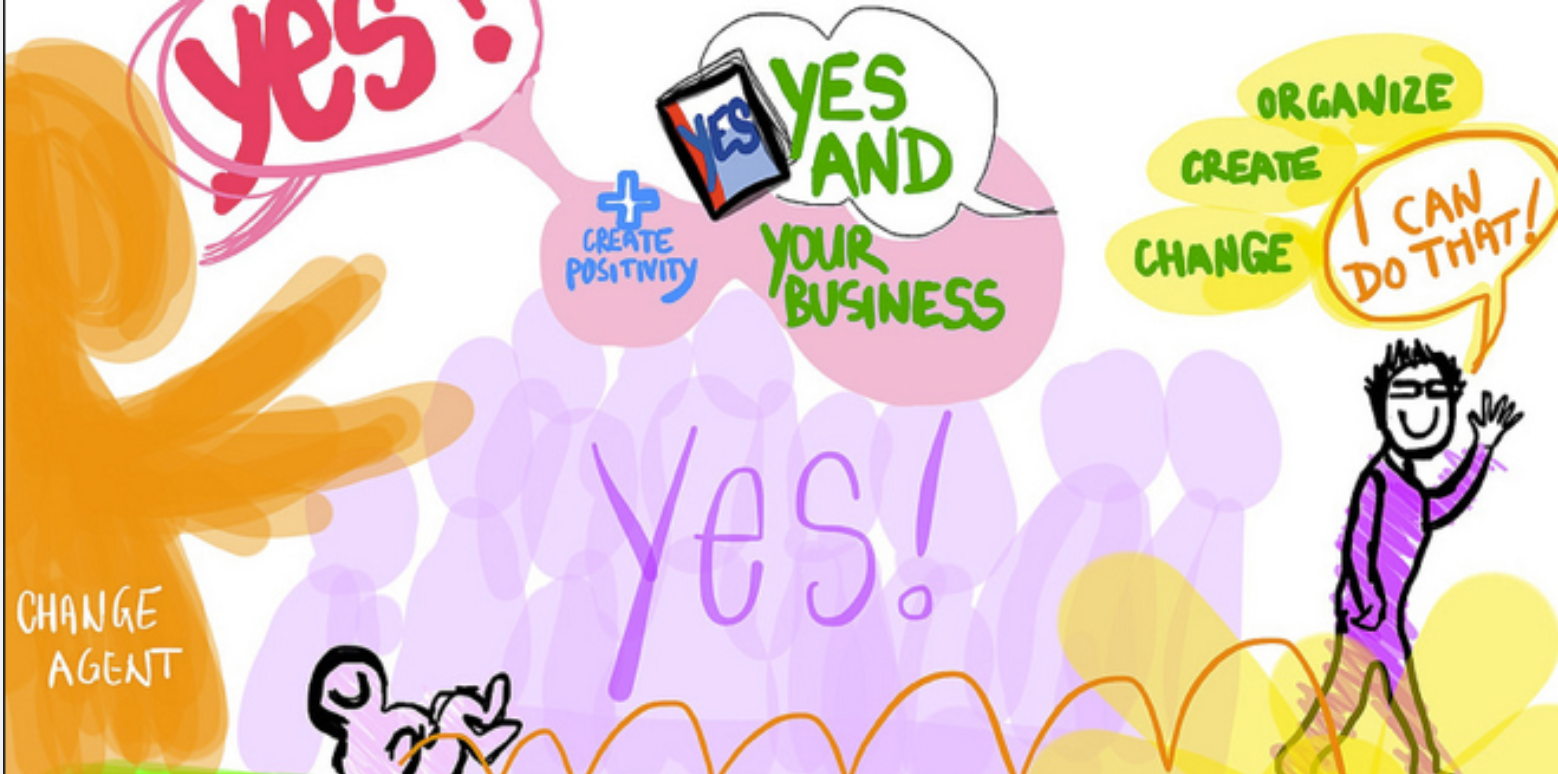
     The first rule of improvisation is AGREE.  Always agree and SAY YES.  When you’re improvising, this means you are required to agree with whatever your partner has created.  So if we’re improvising and I say, “Freeze, I have a gun,” and you say, “That’s not a gun.  It’s your finger.  You’re pointing your finger at me,” our improvised scene has ground to a halt.  But f I say, “Freeze, I have a gun!” and you say, “The gun I gave you for Christmas! You bastard!” then we have started a scene because we have AGREED that my finger is in fact a Christmas gun.

    Now, obviously in real life you’re not always going to agree with everything everyone says.  But the Rule of Agreement reminds you to “respect what your partner has created” and to at least start from an open-minded place.  Start with a YES and see where that takes you.

    Don’t click away yet; humor me for just a moment.  What appeals to me in Fey’s description of the Rule of Agreement is a recognition that the impulse behind your colleague’s work comes from a good, or at least neutral, place.  It’s a momentary staving off of the impulse to assume that someone else’s scholarship is fashioned out of ignorance or apathy or even ill will or that the conversation was initiated in bad faith.  Agreement doesn’t have to be about value: it’s not even about accuracy or support.  The Rule of Agreement is a social contract to respect the intellectual work of your peers.

    To incorporate the first lesson of improvisation into digital humanities practice (and many if not most practitioners do this already) means to respect that there was intellectual work, time, and experience that went into its creation, and that we value the time, attention, and experience of our peers enough to approach it first with a willingness and openness to its value and its potential contribution to scholarly conversation.

    If, as most people who write about the field seem to agree, digital humanities work thrives on collaboration and a vital intellectual community, then the success of that social contract begins with an impulse to respect each other’s work.  Perhaps, after this initial scene Fey describes, the first speaker tosses the “gun” aside screaming, “Help me! I was put up to it by the evil Dr. Doofenshmirtz!” or the second speaker decides to kiss and thereby disarm, the first.  The conversation can change without starting out in the negative.

    Possibly, the scholarship in question may be cast aside in favor of something that does a better job of propelling the scene (field) forward.  It may be that we decide later that we want the scene (field) to go another way.  That’s fine. But what I think is important is that our first impulse is to respect one another’s contributions, and begin our discourse from points of agreement that then moves toward a conversation about where ideas, methodologies, and convictions diverge.  The Rule of Agreement is the best way to keep the open, collaborative, and generous community of digital humanities scholarship vibrant because it is an environment in which those who take risks are most likely to thrive.

    Take, for example, the recently announced issue of the Journal of Digital Humanities, which features topic modeling.  (Note: Yes, yes… this is shameless self-promotion.  Read my article!)  There are some excellent examples of what I’m describing here.  For example, Matt Jockers responded first with a tweet: “Home sick today:-( Thank goodness for #JDHTopics JDH V2 n1.  Fantastic issue with fantastic eds and contributors. journalofdigitalhumanities.org.”  As another example, Michelle Moravec responded to entries by Megan Brett and myself by live tweeting her reading.

    The emphasis here isn’t the orientation toward praise in these tweets (Although, praise is nice: who doesn’t like praise?).  The emphasis is a demonstration to accept by acknowledging and reading.  The conversation extends beyond scanning the table of contents and saying, “No more topic modeling, please!” (Yes, I know there are plenty of DHers who are sick of topic modeling.  I can’t blame them… but you should still read my article!).  The real power in the Rule of Acceptance is that it should lead us to the second rule: Yes, And.

    The second rule of improvisation is not only to say yes, but YES, AND.  You are supposed to agree and then add something of your own… To me, YES, AND means don’t be afraid to contribute.  It’s your responsibility to contribute.  Always make sure that you’re adding something

    Matt Jocker’s next tweet this morning does just that: “Inspired by new #JDHTopics, I’ve posted some lessons learned from topic modeling literature + my “secret” recipe;) matthewjockers.net/2013/04/12/sec…”  Successful scholarship, like improvisation, depends on generosity.  The “and” part is where you can take a conversation and refocus it.  For example, Matt’s approach to topic modeling and my approach to topic modeling are different.  However, Matt’s blog post on the LDA Buffet helped kick off my own work.  We take similar tools and use them for divergent purposes to answer different kinds of questions, and I think that’s what’s so brilliant about the second rule of improvisation.  Yes, And  creates diversity in scholarship rather than silencing it.

    I suppose this is why I put the Topic Modeling Game that I created into a GitHub repository.  If it sits on my hard drive waiting some day for a publication that might happen 2-3 years from now, I’m not operating within the spirit of Yes, And.  Perhaps, CC-BY and Creative Commons licensing, GitHub, Stack Overflow, and Digital Humanities Questions and Answers are some of the best discipline-wide examples of the rule of Yes, And.

    While disagreement may be native to scholarly discourse, agreement and openness complemented by intellectual generosity, I believe, are benchmarks of confident and prolific scholars.  This is particularly true in the digital humanities.  Digital humanists who seem to gain the most traction in the field also follow the third rule of improvisation: make statements.

    The next rule is MAKE STATEMENTS.  This is a positive way of saying “Don’t ask questions all the time.”  If we’re in a scene and I say, “Who are you? Where are we? What are we doing here? What’s in that box?” I’m putting pressure on you to come up with all the answers.

    In other words: Whatever the problem, be part of the solution.  Don’t just sit around raising questions and pointing out obstacles.

    If the community in which you are operating has really embraced the first two rules, then the third and fourth come much more easily.  I’ve already mentioned the collaborative nature of digital humanities, and directly following “respect your fellow collaborators,” the best advice as to how to be a good collaborator is to do more than just ask questions.  Show that you are committed to the conversation by also taking a risk and presenting new ideas along the way in your research.  This is where social media, experiments like Digital Humanities Now, and scholarly blogs are so important to the field of digital humanities.

    Questions posed in the spirit of “awareness raising” are necessary, but in presenting them, it’s incumbent upon the askers to take a first stab at answering the question themselves.

    Suffer me this allegory, if you will.  A couple of nights ago, I was rustling around the kitchen far too late in the evening trying to figure out what to make for dinner.  I had a bunch of leftovers out on the counter: roast pork, broccoli, mac and cheese, rotisserie chicken, tortellini, fixings for salad.  My 9-year old daughter wanders in, clearly hungry, scans the food on the counter, looks at me and says, “So, are we ever going to eat tonight? … Just asking…”

    Clearly, she knows we’re going to eat.  Sure, Jason and I have been known on occasion to pull out boxes of cereal and the milk and tell the kids this is “breakfast for dinner” night because we were too exhausted to cook… but there’s no real precedent for not feeding the kids.  She knows that.  She’s using the question because what she wants is to know that I have an answer all ready for her.  She wants me to say, “We’re going to order cheeseburgers and French fries with milk shakes.”

    That’s not what I said.  What I said was, “Sure.  It’s left over night.  Get a plate and make it yourself.”  She needed help opening containers and slicing off pieces of chicken breast, but ultimately she had a plate of food that reflected what she didn’t realize she’d already learned about putting together a meal.  She was so proud of having “cooked” her own dinner (read: microwaved…. read: lukewarm… read: dried out…), that she ate every bite of what she was disinclined to even try 5 minutes earlier.

    What’s the point?  Asking questions is important, but sometimes we ask questions because we lack the willingness or the time or the intellectual effort to make statements ourselves.  And in the end, as Fey explains with too-many questions in improvisation, we are forfeiting our responsibility to be part of the solution.  And, as my 9 year-old daughter discovered, we may like our own statements better than the responses we might get from others.

    Essentially what she asked was meant to bait me.  She wanted more reason to be upset.  But being upset doesn’t solve the root of the problem: she was hungry.  Making her dinner solved that problem, and then some.  Of course, it wasn’t the tastiest dinner in the world… but that leads me to the next (and I promise the last) point.

    THERE ARE NO MISTAKES, only opportunities.… In improv there are no mistakes, only beautiful happy accidents.  And many of the world’s greatest discoveries have been by accident.

     When I was revising my entry for the Journal of Digital Humanities, I discovered that one of the biggest “take aways” from the model I was presenting had nothing to do with ekphrasis or gender at all.  It had to do with race and elegy.  In the first draft, I had attributed two poems to Paul Laurence Dunbar—“We Wear the Mask” and “The Slave’s Complaint.”  Initially, I had used the model’s grouping of the two poems together to show how well the model had worked.  In another article from a few years earlier, Dunbar, it was argued was the first to have written about African American identity through elegiac verse.  However, going back and checking all of my links, I noticed that “The Slave’s Complaint” was, in fact, written by George Moses Horton, whose publication predates Dunbar’s work by almost 100 years. If we’re looking for an origin of the use of the elegiac in African American poetry, Horton presents an interesting and uninvestigated new avenue to research.

    By all accounts, this is the holy grail of DH—something new discovered among “known” data to be chased down, researched, and proven or disproven.  But, the finding itself isn’t about ekphrasis… or gender… or most of the other questions I was asking.  It was a mistake and a fantastic discovery on two different fronts that can lead to something completely new.  First, it demonstrates usefulness for my approach, even if it isn’t what I’d intended.  And second, there’s a distinct possibility that it can become the origin story for a discovery about African American literature that we didn’t know to ask.

    In the end, the digital humanities I want to see (and that I believe in many ways already exists) is similar to improvisation—generative, collaborative, even playful—and as a framework for how we engage in scholarly discourse, Fey’s “rules of improvisation” seem like a good place to start.

    Fey, Tina. Bossypants. New York, Boston, London: Little, Brown and Company, 2011.

    **quotations taken from pages 84-5 in the print edition**