
Tag: pedagogy

  • Can “Art Direction” make better digital projects?

    Can “Art Direction” make better digital projects?

    Art direction is not a phrase that I was familiar with in the context of data visualization until I listened to a conversation between Alli Torban, host of the podcast Data Viz Today, and information designer Gabrielle Mérite on Episode 59: How Art Direction Can Make Your Work More Effective. This isn’t a recent episode (November 24, 2020), but the conversation between Torban and Mérite touches on a timeless aspect of visual display of information, which is to say its affective power. Art design, according to Mérite, is the ability to communicate the rhetorical, emotional, and ideological aspects of data in ways that resonate with the audience and with the message. Mérite explains:

    To me, the difference between design and direction, because I think the issue is that most people don’t know the difference, [is that] designis more about problem solving and finding those design solution[s], the visual solution, and art direction is about evoking the right emotion. It’s a bit … about creating that connection between what you’re seeing and what you’re experiencing.

    In other words, in the process of creating effective data visualizations, art direction is a part of the process that integrates the layout, framing, text, and image with the needs of the audience and the message from the data. When the emotional register matches the message (not merely the medium à la Marshall McLuhan), that harmony increases the power of the story the data tells. The idea of art direction may be most familiar in the context of developing a “brand.” In brand design, designers send clients extensive questionnaires that dig into the values, goals, aspirations, and feelings that the clients would like to evoke in relationship to their brand. Setting aside the corporate-speak for a moment, the need to create a cohesive look and feel, user interface, and style guide for a digital humanities project is quite similar. When a project successfully connects with its audience through content and design, the project seems to do more that the sum of its parts.

    How, then, do we teach and evaluate affective coherence within a digital project’s graphic design and user interface? What kinds of skills and literacies do we need to help students develop in order to extend their reasoned, logical, and deeply researched scholarly investigation to include the affective and often rhetorical arguments their projects make to the design, implementation, and administration of those projects?

    As a capstone and thesis advisor, I find this to be one of the tricker aspects of the project to cultivate, because doing so depends upon dialog, iteration, feedback, and sometimes even redesign and change. They are part of a project’s development that extend the timeline of the work, which–in turn–is also a hurdle to completion. The typical capstone project should take only one semester; however, really leaning into the “art direction” of the project means taking time to test, reevaluate, and redo, something that is likely to carry the project on beyond the single semester.

    So far, the way that I have begun to address concerns like these is at the proposal stage. When I’m reading a project proposal for a capstone now, I find myself asking students how they want the audience to feel and how feeling and affect are going to be addressed through the interface or visual and verbal signals embedded into the work. Whether or not that plan is fully realized in the single semester, to me, is less important than evidence that the student has taken time to consider and to account for the “connection between what you’re seeing and what you’re experiencing.” What I say now is that I’d like there to be evidence of intentionality in the project, such as a purposeful selection of color, texture, organization, or technology choice, that extends beyond utility to creating a cohesive experience between the audience’s visual experience and the information conveyed. While the realization of that cohesion may be uneven in the final project, the white paper the student submits should explain where there is evidence of artistic direction in what was produced and what steps the student would take in the future, were they to extend the project, to more fully realize that intent.

    Looking ahead, when I teach in the future, I plan to make changes to my syllabus in order to spend at least one week on art direction, design, and affect. I think that more readings on design, on metacognitive processing and memory, and affect theory will help students to be better prepared to marry the design and the information of the site and to think about the ways in which we create a future for the work that conveys not only what users / audiences learn but how they come to knowledge.
  • DHRI: Notes toward our pedagogical approach

    DHRI: Notes toward our pedagogical approach

    The entry below offers a very brief overview of our pedagogical philosophy and the rationale behind the Digital Humanities Research Institutes.


    The DHRI curriculum places great emphasis on foundational technical skills, and roughly one-third of all sessions at the Institute could be described as foundational. These skills—the command line, Git, Python, and data—represent flexible technologies predicated on fundamental concepts in computational literacy. In learning the command line, for example, students begin to conceive of their computing environment as a “stack” of technologies and are introduced to the use of a text editor for writing code and markup. We emphasize foundational skills because we believe that it is the most effective path toward enabling digital humanities researchers to become self-teachers and mentors in their own right. Many bootcamp-style intensives prioritize instrumental outcomes, such as whether students can write a for loop or build a map. While immediate results are desirable, we find that students who know how to use the command line, read technical documentation, and reason about simple systems are more self-sufficient and better able to approach technology (and technological rhetoric) with a critical eye. This leads to second- and third-order effects as students teach themselves and teach others, and also provides a common conceptual vocabulary and skill set that serves as a basis for collaboration within the community.

    The difference between an instrumental approach and a foundational approach is often not immediately appreciated by participants, but over time they begin to change their minds. Although an instrumental approach satisfies a researcher’s most immediate need, a foundational approach takes into consideration the long term impact that learning core skills will have for the future professional and research needs of the scholar. For example, a historian who wants to produce a digital exhibit of archival materials at a local historical society may choose a recognizable tool like Drupal, then look for training opportunities that help learn how to create a Drupal site, select an appropriate theme, and use the Drupal “exhibit builder” plugin to develop a publicly viewable resource. While approach satisfies the immediate need for a collection, it does not provide the researcher with the skills to decide if the next project is appropriate to Drupal. In a foundational approach, the same historian would learn how to use databases, how to construct effective queries, and why consistent metadata matters. While the researcher may still choose to use Drupal to create an online collection, knowing the underlying technologies will inform that choice and help with troubleshooting problems, asking for help on forums, or collaborating with teams of programmers and designers.

    DHRI grew out of our annual Digital Research Institute for GC students and faculty. Initially supported by a CUNY-wide Strategic Investment Initiative grant with continued funding from the Provost’s Office, GCDI has hosted five week-long, interdisciplinary Digital Research Institutes between January 2016 and January 2019 (cuny.is/gcdri) that have introduced more than 160 participants ranging from first year master’s students to doctoral students, librarians to senior tenured faculty to digital skills. Our DHRI curriculum is based on the lessons developed for our in-house institute. As a result, we are continuously updating and iterating throughout the year. Led by Lisa Rhody, the GC Digital Fellows collaborate throughout the year to develop a critical pedagogical approach that is designed to meet the needs of a diverse population of graduate students and faculty researchers. Tenants of our workshop pedagogy include challenge-based learning, theory through practice, multimodal delivery, a pragmatic approach to computer literacy, and an emphasis on foundational rather than instrumental learning.


    https://docs.google.com/presentation/d/e/2PACX-1vT3tRjJ-uIGiRe5BFT2hvZguZgCYeawXSHBbGYilrf2MPgAZ8XatS4k_rSm1Ie8eeOAyvERRDl0fO6_/embed?start=false&loop=true&delayms=3000

  • Closing Remarks: Digital Humanities Research Institute, June 2018

    Closing Remarks: Digital Humanities Research Institute, June 2018

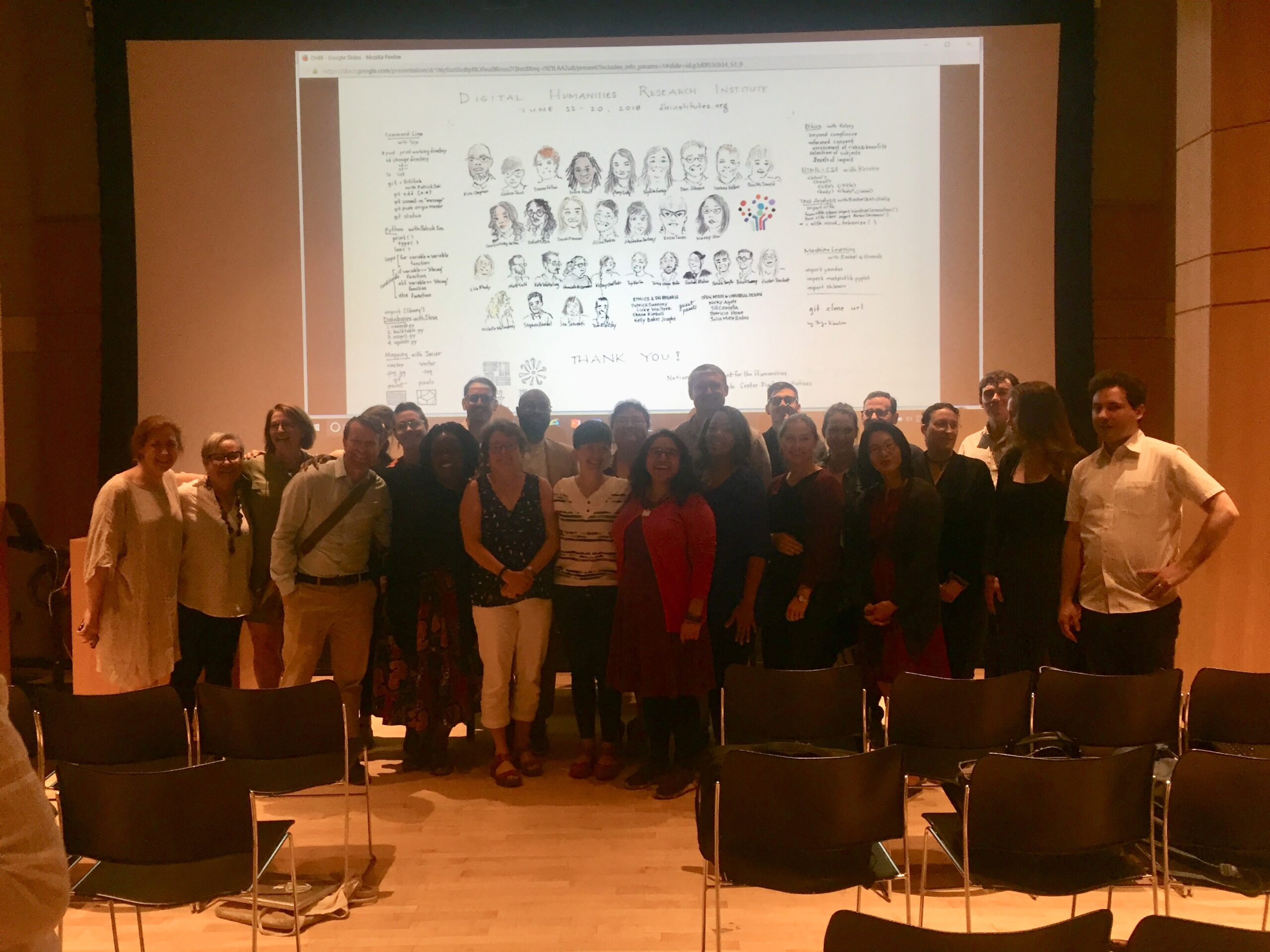
    The following are my comments from the closing public lightning talks by participants from the Digital Humanities Research Institute on June 20, 2018. Tomorrow, participants will return to The Graduate Center, CUNY to share their progress and to begin drafting recommendations about leading Digital Humanities Research Institutes (DHRI) at your own institution. The slide show from the lightning round presentations can be found below. Follow us on Twitter at @dhinstitutes and #DHRI to hear more Monday, June 17 – Tuesday, June 18th to her more.

    Welcome to those of you physically present here at the Segal Theatre at The Graduate Center of the City University of New York and to those of you following along on the live streaming of our event, to the concluding ceremony of the NEH-sponsored Digital Humanities Research Institute (or DHRI) which will feature presentations from our sixteen participants.

    DHRI is an ambitious continuation of work begun well before I arrived at the Graduate Center in 2015. GC Digital Initiatives, spearheaded by Matthew Gold and born out of long-standing faculty strengths in digital humanities, public history, and media studies, centers such as the New Media Lab and the Mina Rees Library, has enjoyed a lively history of creating communities of scholars, technologists, and teachers invested in the critical and creative use of technology to support the research, teaching, and service missions of The Graduate Center and CUNY. While I’m leaving a good bit of hard work out of this brief history, the model in place at the Graduate Center has informed the DHRI through a continued centering of community-based and engaged technology education and use. In 2015, Matt Gold with the help of Patrick Smyth and a number of digital fellows drafted a grant proposal for a CUNY-wide call titled the “Strategic Investment Initiative.” Characteristically, that proposal prioritized the strengthening of our human research infrastructure by proposing two “bootcamps” or digital research skill intensives. When I arrived in December 2015, we were already on our way to creating the first of what would become four Digital Research Institutes over the next 3 years. We believed then, as we do now, that the best approach to growing a technologically engaged and innovative research infrastructure is not through the continued purchase of equipment, but through a continued investment in people. By building a strong community, we improve opportunities for all.

    This has been the guiding ethic behind the GC Digital Fellows program, which is one of three digital fellowship programs that are part of GC Digital Initiatives, and also the guiding impetus toward the creation of these NEH Institutes. In order to create a sustainable, flexible, and resilient community across our CUNY network, we developed a model for digital research methods and skill training in the humanities that we felt could best respond to the needs of our diverse and wide-ranging CUNY network. We wanted to build a sustainable and expanding community of practice, a culture of open exchange, an impulse toward active and iterative learning, and a curriculum that addressed foundational concepts, in order to build a strong base upon which to grow.

    The curriculum that we developed locally here as part of the GC Digital Research Institute, we believed, could serve as a resource to help other humanities communities; however, we felt strongly that the curricular materials themselves did not make the institute. Rather than just posting the curriculum and leaving it at that, we decided to address what we saw as a particular need–that many humanities scholars in a climate of decreased travel funding and increasingly contingent employment contexts–don’t have access to learning foundational technical skills that undergird the learning of more niche digital humanities tools and methodologies. While efforts such as the Digital Humanities Summer Institute in Victoria and HILT offer much needed, highly effective, and even community-oriented approaches to the expansion of digital humanities practice, more support is necessary in local contexts, at HBCUs, at community colleges, at liberal arts colleges, at regional universities, etc.

    With a wealth of experience serving a diverse student population, we felt that our CUNY institutes–more than just a curriculum, but also a pedagogical approach–could be useful to others as a means to bring training to scholars where they are and along the way to support an expanding network of faculty, staff, librarians, and others whose job descriptions included “expanding digital humanities communities” without, perhaps, internal institutional support.

    The DHRI, then, is both a curricular as well as a social intervention into the expanding community of digital humanities practice. Our goal is to provide tried and tested curricular materials combined with a pedagogical approach, assistance with planning and outreach, and connection to a community of emerging leaders in digital humanities research, workshops and methods. So far, this is where our first 10 days together have focused, and what you will see today is a kind of pivot, where participants who came to learn, leave to lead us, lead one another, and lead their campus communities toward thinking about how to best integrate digital methods and research into their local contexts.

    Each participant today will present a brief overview of how they will take the materials we’ve assembled and the conversations here and use them to grow their own communities of practice. Over the course of the year, each participant will have 20 hours of support from us, but more importantly, they’ll continue (as they’ve done so well so far) to learn from one another and support one another–and in turn we will continue to learn from their leadership.

    Next year in June, each participant will return to report back about their experience. In an extension of our own ethic to do the most good with the resources we are privileged to have, our ambition is to use our experiences and our reflections to help those who may also want to build similar dh communities of practice at their local organizations. We hope that our piloting, experimenting, and prototyping will lead to lessons that prove useful for others. And, we have good reason to believe, based on the 137 applications that we received for this institute, that there are many others who are interested in expanding their communities through learning.

    Let me come back to those 137 applications, if I may. We had many strong applications. Each of them made incredibly moving cases for why they and their organization would be an excellent candidate for the Institute. Out of that pool, more than 115 have asked to stay on a listserv so that they can continue to hear updates, see the curricular materials, learn about new opportunities, and follow along remotely. I think all of us feel a real responsibility to continue to keep those who are not here as present in our minds as those who are when perhaps the valuable and necessary work of community-building feels hard.

    Any collaborative endeavor depends upon the shared willingness to participate, to hear, to grow, and to actively engage with one another, and the DHRI is no exception. Fortunately, the group of 16 participants who joined us this week and whom you will hear from shortly have proven to be an outstanding, generous group. I am excited for us, excited for their local organizations, and excited for our own expanding community of practice that they are the ones leading the way. They have been patient and resilient, thoughtful and questioning, and the success of this idea that we can build a network of digital humanities research institutes is in good hands.

    I want to thank Provost Joy Connolly for her support of our GC Digital Research Institutes, and this NEH award. Also, Matthew K. Gold, Advisor to the Provost on Digital Initiatives, has been an important advocate for our work leading up to the institute and throughout our conversations. Stephen Zweibel has been an excellent collaborator who designed new content for the institute and has helped throughout. Also, many thanks to the GC Digital Fellows for teaching workshops, leading discussion, setting up, taking down the room each day, reading exit slips, and taking care of all the details big and small throughout the past 8 days we’ve spent together. They include: Hannah Aizenmann, Jojo Karlin, Kelsey Chatlosh, Patrick Sweeney, Patrick Smyth, Javier Otero Peña, Rachel Rakov, and Kristen Hackett. Also, a special word of thanks to Tom Ribitzky who has done so much of the administrative and logistical work. Of course, much of our thanks go to Kalle Westerling, our Institutes Coordinator, whose efforts during this past week and a half, as well as the previous 6 months, has been invaluable. He has handled everything from name tag design to slides to staffing and supporting workshops. Kalle’s been helping to design curriculum and moderate the GitHub repository, as well as helping to think about how to continue to support your efforts all year long. Please join me in offering everyone a round of applause as we welcome our first set of participants to begin presenting their work.

    https://docs.google.com/presentation/d/e/2PACX-1vQxaiKv0caClHTwcL4ijfskWs2No7-z35tw4rj7puRTw8z9QSle93zoUSdSJJy0fkJIQOhPIrOB920a/embed?start=false&loop=true&delayms=5000

  • Teaching LDA with the Topic Modeling Game

    Teaching LDA with the Topic Modeling Game

    The following post was featured as a Digital Humanities Now Editor’s Choice entry on April 2, 2013.

    In February, I visited Matthew Kirschenbaum’s #ENGL668K Introduction to Digital Humanities course at the University of Maryland, and I brought to class an activity that I had been mulling over in my own mind for a long time, called the Topic Modeling Game.  The game is designed to teach the basic principles of topic modeling with LDA through engaged, constructivist, and problem-based techniques.

    As I was learning about LDA myself, I realized that I was essentially playing this game in my head over and over again: following through how I thought LDA worked, learning where I made mistakes, revising my assumptions, and playing the game all over again.  When I went to write about the results of my topic modeling experiments for the Revising Ekphrasis project in my dissertation, what I discovered is that I really needed a way to explain topic modeling such that someone who had no knowledge of the methodology could read the results of my experiments and trust my conclusions.

    That process led to a written explanation of LDA that will appear in a future article in the Journal of Digital Humanities.  In the essay, I create a hypothetical situation to explain the assumptions LDA makes about natural language texts in order to produce its results.  The example walks readers through the process of figuring out what produce is available at a farmers’ market that they have never been to themselves and asks the reader to consider the problem from a quantitative perspective.  When I created that explanation, I did it by playing this game in my head.  So, I thought, perhaps this could be an effective way of teaching LDA, as well.

    After tweeting something about the Topic Modeling Game, other DH instructors requested copies of the game.  I absolutely wanted to share, but I also wanted to learn from other teachers’ experiences.  More importantly, I wanted other new teachers to benefit from the experience of those who had already tried it.

    Meanwhile, there’s been a lot of conversation about the value of public, open repositories of data.  ProfHacker has had several recent posts about using GitHub to revise documents (see Getting Started with a GitHub Repository and Forks and Pull Requests in GitHub).  Also, Matt Burton presented a helpful introduction to Git at MLA 2013 in the Scaling and Sharing: Data Management in the Humanities special session #s586.

    What better way to share a lesson plan with peers, I figured, than to create a repository for it on GitHub, to invite others to use it and to ask that they share their results and add their changes and revisions back to the repository?

    As a result, I created a GitHub public repository for the Topic Modeling Game.  Currently, in the repository, there are two Word documents.  One includes instructions and background information for teachers.  The other is a rudimentary hand-out to use to begin the game as an in-class (face-to-face) assignment.  The instructor document includes a list of materials that could be used for the lesson, but I have not uploaded sheets of “sample words” to use—at least not yet.

    There is plenty of room to edit, improve, revise, innovate, and share.  The one thing that I do ask is that if you download and use the Topic Modeling Game, you contribute to the repository by adding lessons you have learned, revisions you made, and suggestions for improvement.

    So, bring your forks (again, you may want to read Konrad Lawson’s recent post on forking and pulling with git if you’re unfamiliar with the process) and dig on in.  I’m looking forward to hearing back from those who try it.